
Amos Crane’s Escalation
Down Cemetery RoadAmos Crane’s career as a controlled fixer deteriorates into personal vengeance as his brother’s death turns a covert operation into a final confrontation.
increasing Bearing strength in each event
 decreasing
Bearing strength in each eventdecreasingThe Department’s Enforcer
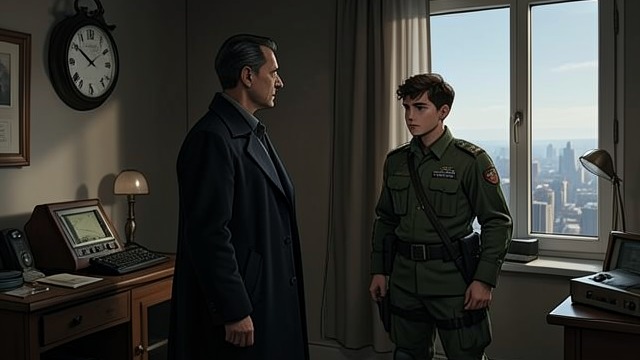
The Department’s Enforcer
A career in concealed violence
Amos Crane has spent decades working for a secret government department that treats politically dangerous information as a problem to be removed. He accepts a doctrine in which violence can be hidden behind accidents, and regards secrecy as a practical condition of government rather than a moral emergency.
His competence has made him useful, while his appetite for dangerous work has made him difficult to manage. He understands the institution’s rules well enough to operate inside them, but increasingly treats those rules as instruments rather than limits.
A brother brought into the work
Amos helped bring Axel Crane into the same world, knowing that Axel was talented and volatile. Their brotherhood is also a professional arrangement: Amos repeatedly tries to control the younger man’s excesses while relying on him to carry out work Amos himself cannot always supervise.
That pattern gives Amos influence but not real command. By the time the Singleton operation begins, his career is built on keeping Axel’s failures manageable, a dependence that will make the consequences of the operation personal as well as professional.
A Bomb and Its Aftermath
A Bomb and Its Aftermath
An operation beyond control
Axel Crane’s bomb destroys the Singleton house, killing Maddie Singleton while failing to resolve the operation’s real problem. Dinah survives, and Michael Downey remains at large, leaving Amos to deal with civilians, a missing child, and a cover story that must be made to hold.
Amos does not treat the disaster as grounds to stop. He helps arrange the transfer of Dinah and works to keep Howard believing that the operation remains manageable, even as the risks multiply.
People reduced to pieces
Amos thinks of the child and the soldiers as positions on a board, useful insofar as they move Downey into reach. He can recognize that the plan is dangerous without allowing that recognition to interrupt it.
This way of thinking marks the point at which his earlier role as Axel’s controller becomes indistinguishable from complicity. He has inherited the consequences of the bombing, but continues to advance the same logic that produced it.
Brotherhood Becomes Vengeance
Brotherhood Becomes Vengeance
Grief recast as mission
When Axel is killed while attacking Sarah Trafford, Amos receives the news as both a professional setback and the death of his brother. He does not pause to examine why the operation has reached this point; he turns grief into a reason to pursue Downey more relentlessly.
The Department’s leadership orders Amos to stand down, recognizing that he is now too personally invested to be trusted. Amos ignores the warning and travels north, treating the pursuit as his own work rather than an assignment.
The hunt narrows
Amos studies train routes and hotel records to track Downey, using the habits of his opponent to infer where he has gone. His methods remain patient and calculating, but their purpose has shifted from protecting an operation to punishing the man who killed Axel.
He also kills the innocent David Keller and takes his identity, showing how far the old distinction between necessary covert action and personal violence has collapsed. A man who once managed cover-ups now creates another death simply to continue the hunt.
The Final Pursuit

The Final Pursuit
A trap that turns on its maker
Amos follows the trail toward the island and then the chapel, expecting to bring Downey within reach. Instead, the operation has become unstable: Dinah has been moved, his agents have died or staged their deaths, and the people he meant to control are no longer following his plan.
His arrival at the chapel is still driven by the promise of a direct confrontation. He sees Downey as the target and Sarah and Zoë as obstacles, not as people whose choices might disrupt the arrangement he has built in his mind.
Violence meets resistance
At the chapel, Zoë Boehm shoots Amos before he can kill her or Downey. The narrative treats him as no longer a problem, ending the career of a man who had spent his life arranging other people’s exits.
His final failure is not that he lacks skill, but that he assumes everyone else will hesitate in the way he expects. The belief that he can always control the timing of violence brings him to the chapel—and leaves him defeated there.
Before the Singleton operation
The night the Singleton house explodes
After Michael Downey kills Axel Crane
On the island and at the chapel near the ending
